
Navigating the Opportunities and Risks of Brazil’s Business Landscape
Navigating the Opportunities and Risks of Brazil’s Business Landscape
UCLA Anderson students learn hands-on in São Paulo and Rio de Janeiro
Feb 5, 2026

- UCLA Anderson’s Center for Global Management offered students a global immersion to understand the opportunities, challenges and risks of doing business in Brazil
- Led by Adjunct Professor Eric Sussman, the course took 34 students and alumni to São Paulo and Rio de Janeiro
- Sussman, a real estate investment executive, has been teaching internationally for more than 20 years
Leon Lehmann (’26) is pursuing a UCLA Anderson MBA with a specific goal: to build an international career focused on Latin America. “Long term,” he says, “I plan to return to Chile and participate in regional private investment platforms, making a deep understanding of Brazil — the region’s largest and most influential economy — essential to my career path.”
Lehmann grew up in Chile, but until he started graduate school in L.A., he had never traveled to Brazil. With concentrations in real estate and private investments, Lehmann found an ideal learning opportunity in the fall 2025 class Navigating Brazil’s Business Landscape, which took Lehmann and 33 other Anderson students and alumni to São Paulo and Rio de Janeiro. Taught by Adjunct Professor Eric Sussman (B.A. ’87), the course is tailor-made for someone with Lehmann’s ambitions.
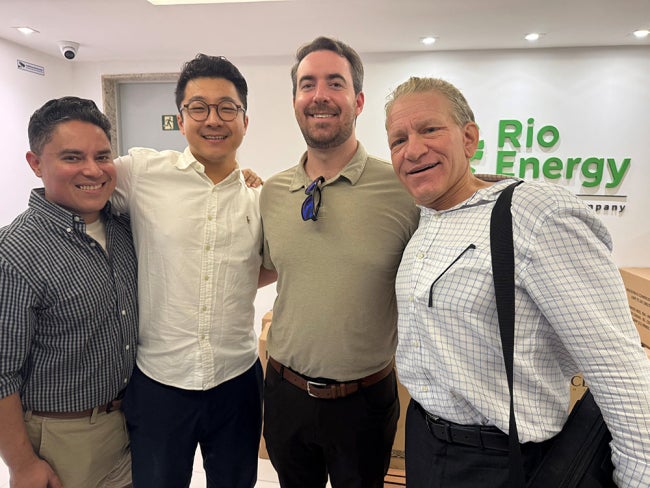
Sussman is co-founder and managing partner of Clear Capital LLC, a real estate investment firm. He began his career as an audit manager at Price Waterhouse as a third-generation UCLA graduate. He created the analytical software tool Insight FSA™. Since 2010, Sussman has led Clear Capital in the areas of private equity, joint ventures and fund formations, and he has served on boards and as a consultant to firms whose portfolios consist of industrial, retail, and multifamily and single-family residential properties.
For even longer, though, the Stanford MBA has taught courses in accounting, finance and real estate at Anderson, where he is an eight-time winner of the MBA Teaching Excellence Award and a seven-time winner of the FEMBA Teaching Excellence Award. “Accepting an offer to teach as a means of earning some additional income may have been one of my more auspicious decisions,” he says.
Sussman joined the faculty in 1995 and dove headlong into leading groups of students overseas for immersive learning experiences in regions as different from each other as Scandinavia and the United Arab Emirates. By 2025, Sussman had been teaching in FEMBA’s Global Access Program and the Center for Global Management’s global immersion series for more than 20 years. He has lectured in 14 countries to date, focusing primarily on emerging markets. Like his students, he has to acquaint himself with each nation’s economy, political environment, major industries, culture and key historical events — and every trip requires a refresher on local and regional economic and geopolitical developments. He’s considered a resident expert on Finland and Dubai.
But he was asked to teach GAP courses before he had thought about which countries might interest him most. “The word ‘no’ isn’t in my vocabulary as much as it maybe should be,” he laughs. “Like in any business, you assign and allocate resources where they are needed, and that’s what Anderson does.”
Sussman describes it as a sharp learning curve but second nature to an Angeleno already conducting and teaching business at the center of the Pacific Rim. “We’re international,” he says. “Our exposure to Latin American and Asia is obvious. Anyone who’s doing any kind of business education in California must be a globalist.”
“What stood out most was not just what these companies do, but how they do it within Brazil’s unique regulatory, cultural and macroeconomic environment.”
— Shannon Sherwood (EMBA ’27)
Anderson’s global immersions entail a pre-travel series of lectures, one week in country and another class session on return. Final deliverables for the 2025 Brazil immersion include a research project and written assignments. “It’s largely self-directed education,” says Sussman. “Number one is to understand the opportunities, challenges and risks of doing business and investing in Brazil. Latin America is, in many respects, 10 years behind the United States when it comes to, say, financial products and medtech. Another example is real estate investment trusts, something I teach that’s close to my heart. We formed them in the U.S. in the late sixties, but they didn’t take hold in Latin America until the 2000s. So if one of our students with an entrepreneurial bent gains the knowledge, they can go to Brazil and form a REIT because no one else is doing it. There you go.”
Meanwhile, as Latin American business sectors enter different phases of their evolution, imitation may be the highest form of flattery. Sussman says there’s plenty of opportunity for Brazil to supplant imported innovations — like rideshare services and online banking platforms — with native versions. He’s currently advising and potentially collaborating with former student and Brazil native Gustavo Burgos (’22) on sponsored investment vehicles in the south of the country, where Burgos has gauged demand.
“The so-called Brazilian Cost discourages many foreign companies from expanding there,” says Lehmann. “The course reinforced the importance of evaluating investments through a regional and institutional lens, not solely a financial one. I developed a clearer understanding of Brazil’s economic complexity, particularly how macroeconomic volatility influences business strategy and capital allocation.”
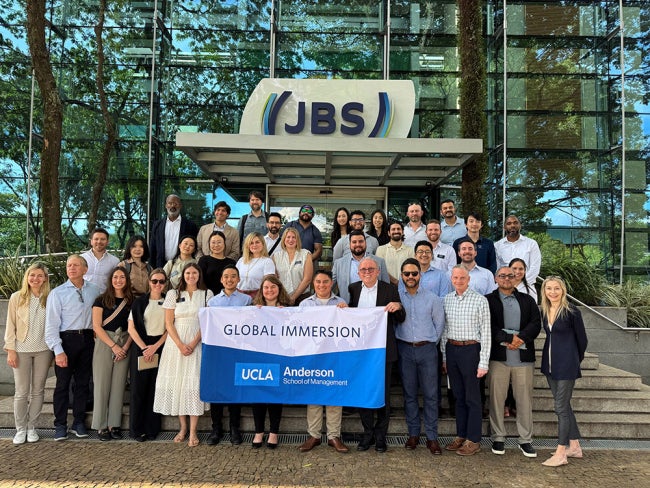
Lehmann, who was a real estate development manager in Santiago before enrolling at Anderson, feels fortunate to have experienced Brazil in an academic and professional context. “Learning about Brazil’s real estate and capital markets revealed both structural constraints and long-term investment opportunities,” he says. “I can immediately apply this framework when analyzing cross-border opportunities, especially in real estate and alternative assets, by incorporating considerations such as market depth, regulatory frameworks and capital availability. Looking ahead, these insights will directly inform how I structure and assess investments across Latin America.”
Lehmann’s classmate Shannon Sherwood (EMBA ’27), a tech sales manager and strategist with a background in finance, says the Brazil immersion changed how she thinks about business, culture and participation in the global economy, too. “The intent of the immersion was clear: to understand what it actually takes to do business in Brazil,” Sherwood says. “In São Paulo and Rio de Janeiro, we met with a wide range of organizations — each offering candid perspectives on their operating realities, competitive challenges and the trends shaping Brazil’s economic future.”
CGM’s executive director, Lucy Allard (’06), adds, “This fascinating country has grown and changed substantially since the end of military rule in the mid-1980s.” Sussman’s course, the sixth global immersion focused on Brazil, took students into conversations with executives in consumer goods, health tech, venture capital, energy, infrastructure, mobile communications and live entertainment that “illuminated how purpose-driven leadership, technological change and operational excellence are shaping outcomes in the largest consumer market in Latin America,” as Allard puts it.
“The course reinforced the importance of evaluating investments through a regional and institutional lens, not solely a financial one.”
— Leon Lehmann (’26)
Among the cohort’s in-person meetings was one with Luiz Oscar Niemeyer, president and chief executive officer of Bonus Track Entertainment, and his daughter Luiza Niemeyer (’19), chief financial officer the company. “What stood out most was not just what these companies do,” says Sherwood, “but how they do it within Brazil’s unique regulatory, cultural and macroeconomic environment. Experiencing these conversations on the ground — rather than from a case or classroom — deepened my cultural awareness, sharpened my business judgment, and reinforced the importance of context when making decisions in a global market. It was a powerful reminder that being effective in today’s economy requires curiosity, humility and the ability to learn directly from those closest to the work.”
For Sussman, the happenstance pedagogue whom BusinessWeek once named one of the 10 most popular business professors in the U.S., “To be able to go to another country and also learn while teaching is an extraordinary opportunity. Every time I step into a classroom, I try to make students feel like it’s the first time, because for them it is. I think that’s important as a teacher, that you have that same enthusiasm, energy and interest you did as the first time.”