
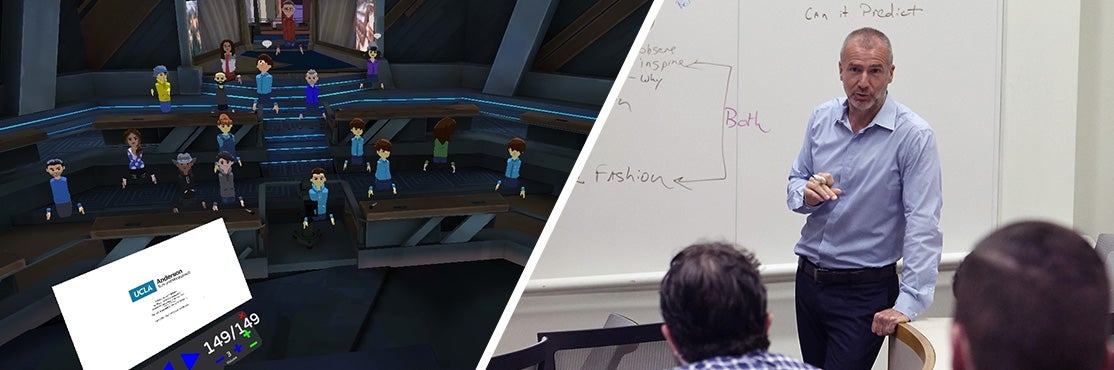
UCLA Anderson alumnus John “J.B.” Blevins (’11) is a technology strategist who works at the intersection of high-tech sectors such as aerospace, biotechnology, computer engineering, information technology, software/hardware and telecommunications. He is founder and managing partner of Navigation Pointe, which provides management consulting services in the areas of corporate strategy and organizational management for technology-based businesses. Blevins creates digital transformation plans that enable traditional enterprises — whether governments, corporations or academic institutions — to compete in a digitalized business environment. As an adjunct assistant professor at Anderson, he brings that extensive industry experience into the classroom. In February 2021, he delivered a one-hour lecture on the business impact of artificial intelligence to students in his Cloud Computing and Big Data course in what may have been the first live VR classroom experience at UCLA.
This tech management class is really teaching both technical and non-technically oriented MBA students about these powerful cloud and big data tools that have enabled new business capabilities.
I look at them as business management tools. I feel like everybody who runs a business — any executive leader, any organizational leader — needs to know about them. They don’t need to know the deep-dive details, but they need to understand them well enough to know their capabilities.
This class exposes students to the basics of how it works, and then how you leverage those technologies to create new opportunities. The opportunity could be a deliverable, a product; or it could be greater efficiency in your operations; or it could be a better understanding of your customers through data mining.
Recently, I’ve altered the course a little bit. When I first started teaching it, this technology was really new and intrigue was high. Now, I think our new students have grown up with more of it in their careers. Before, the students didn’t know anything, now they actually come in pretty well versed, which has allowed me to dive deeper into areas and cover a wider variety of topics.
It’s funny that you mention TikTok.
I’ll often ask in class, “How many students use TikTok?” Half of the students will raise their hands. I’ll pick someone and ask, “How does this algorithm work? How does TikTok understand what you want?” And every time I get this “oh-my-gosh” moment when they share their realization that they didn’t give the app any information, yet within an hour the app knew them.
I’ll turn to a student who’s never been on it and ask, “Why haven’t you?”
I challenge the students to be inquisitive. I share that, for a business executive, Tik Tok may be a complete waste of time and the whole class laughs. Then I tell them they should “waste” an hour after class using it.
They need to experience how, within an hour, Tik Tok figures them out. The algorithm is so powerful, and they can feel that first-hand. When any new technology comes out, I always encourage them to sign up for it. Never lose that inquisitiveness as an executive to stay ahead of the competition.
First let me share a little bit about the premise of the class.
With cloud computing, we now have the ability to store big sets of data. When we have the ability to store sets of data, we can interpret it, crunch the numbers if you will. That’s “big data.” Once we can crunch big data, we can learn things and figure things out — that’s machine learning. Once a machine learns things, it could make logical decisions, and that’s artificial intelligence.
I want the students to understand this is what business leaders seek — new insights. Leaders want to understand what’s going on in their company, what’s happening in their warehouse, what their customers want. Data is the new gold; it helps them make better decisions.
The reason I decided to teach in virtual reality is the data that’s needed to create a 3D world you can actually see in a headset is mind boggling. With companies like Meta putting billions into this, virtual reality is becoming part of the common consciousness, and my concern was that our Anderson students didn’t recognize that yet.
The concept behind the VR session was that students could see how much data enabled new capabilities. And in this case, the capability was this virtual classroom I made, with little pictures of the Anderson campus around the room and with me being able to talk to them and look at them while I wasn’t even there. It was a virtual me, an avatar that looked like me and, of course, sounded like me as I led the lecture.
I think they started getting it. The students could talk to one another, and they could interact with one another. It was immersive enough that it blew their minds. We just did one hour, one lecture in VR, and that hour gave them the ability to experience VR. And their reaction was, like, “wow.”
It’s going to morph into a course about cloud vendor management. Think about a company today: Firms have a bunch of computers in the data center and they’re slowly getting rid of them because they can give the work to Google or Amazon or Microsoft. Those companies can run things better, faster and cheaper. Every business plan today from a startup has a line item in it about data management and data assets, and it’s always a cost to some vendor. In the Unites States, that’s Google, Microsoft, or Amazon. It might be IBM or Rackspace. In China, it’s Alibaba, Baidu or Tencent. It’s a line item. It’s like hiring an accountant. It’s just a part of doing business these days. So, I think the future for these classes will emphasize effective vendor management, vendor relationships and, of course, you must know what services you’re asking for, so you need the knowledge of what cloud computing can do.
More generally, after students understand cloud and big data, the next thing they should understand is machine learning and artificial intelligence. I think we’ll have more classes on the application of new technologies, the application of robotics, autonomous vehicles, drones, and things of that nature. Those are going to be things that future business leaders are going to have to understand.
It’s an elective class that’s two units, not four. Instead of a 10-week quarter, we do the first five weeks of the quarter. I have found the students like to take it during the first five weeks of the quarter, allowing them to spend the rest of the term on their core classes, which they appreciate during finals week.
We have five guest speakers and, of those five, three come from the big cloud vendors. I always have Google, Amazon and Microsoft join us. I’ve got great speakers lined up so students can actually talk directly to the cloud providers themselves. For most students, it’s the first time they’ve ever met someone from Google or Microsoft or Amazon. It’s always a good conversation.
I always have students go do research using live big data sets. I allow them to pick any topic for our final.
If they want to ask, “How can big data solve global warming?” I provide them a list of online data sets to use, and they always find new ones their own, too. I ask them to “go online, out on the cloud, and crunch through these data sets so you can understand how this data works.” You can’t direct a team to go crunch data if you’ve never done it yourself. So, they gain the experience of using a large data set and then they create a report and presentation on the findings for their final.
I’m an alumnus and I want to give back. The dean asked me to teach this course, and they keep asking me back each term because students really find it valuable. I’m happy for that.
But it’s more about the students. Humans want to help humans; I really believe that it’s in our nature. I bring real-world stories and my experiences into the classroom and the reception is remarkable, I can see that in their reaction. Then I get feedback from that interaction. Students ask me questions, and it forces me to stay on top of my game. It’s forcing me to think, “How do I explain Kubernetes?” Because I also have to explain it to senior executives who are making multimillion-dollar decisions on these technologies. I literally have to break it down into something that anyone could easily understand. And when I do that, we all gain from the knowledge and understanding.