
A Transformational Legacy
A Transformational Legacy
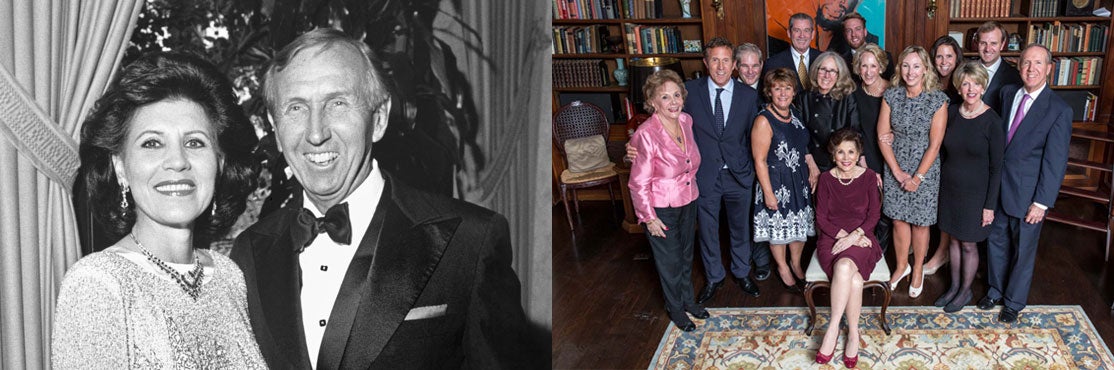
Long after he put away his skates, John E. Anderson (B.S. ’40) kept a hockey stick stashed in one corner of his Century City office. Although its slap shooting days were in the past and it featured a worn handle and fraying tape on its blade, it served as a metaphor: a reminder that competitiveness and hard work are essential elements of success, and that doing the work one loves is truly a gift.
It was a hockey stick that brought John Anderson to UCLA. Born and raised in Minnesota, he was recruited to play hockey for the Bruins. With barely enough money to get to California, he headed west as a driver for an elderly woman who needed chauffering to the Golden State. John’s scholarship provided $60 per year for tuition, but no place to live or any funds to live on. His coach got him a job with North American Aviation, as, among other things, a riveter, where he’d put in shifts of up to 10 hours and which he often took on after working a few hours for an accountant. He slept in the basement of a fraternity house, earning the nickname “Ghost” because he came home so early in the morning after a night at the aviation factory.
John met the woman who would become his wife, Peggy Stewart, while both were UCLA undergraduates. John became very close to the Stewart family at this time and by graduation he and Peggy were engaged.
After graduating in 1940, John proudly gave his UCLA dean what he thought was exciting news: four years of overnight shifts had paid off. North American Aviation had offered him a night manager’s position. According to Judy Munzig, the Andersons’ daughter, the dean had other ideas and told John he should attend business school. John told the dean he lacked the funds. “Let me see what I can do,” said the dean, who soon provided John with an application to Harvard Business School. John was accepted with a scholarship. While at Harvard, he fed his insatiable work ethic by coaching high school hockey and tennis and by running a laundry service for Harvard students.
John was a student at Harvard on December 7, 1941, the day Japanese warplanes bombed Pearl Harbor. He graduated, then joined the Navy, serving during World War II. John and Peggy married during the war, in 1942.
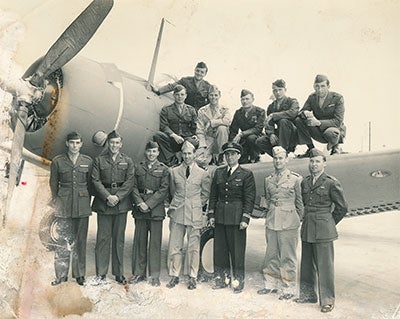
While in the service, John studied to become a certified public accountant. After the war, he and Peggy returned to California and John took a job with Arthur Andersen as a CPA, the family all living in a tiny apartment.
“Dad worked as a CPA during the daytime and went to law school at night,” says Judy. “There was only one law school that had night classes, which was Loyola. On the day he finished, (Loyola’s) dean asked him if he would join the faculty at Loyola Law School. So all during our childhood, he was a professor at the law school.” Daughter Sue McKinley remembers helping her father grade papers. “He became involved in business in the 1950s and bought his first company,” Sue says, recalling that he borrowed money from a client to make the deal.
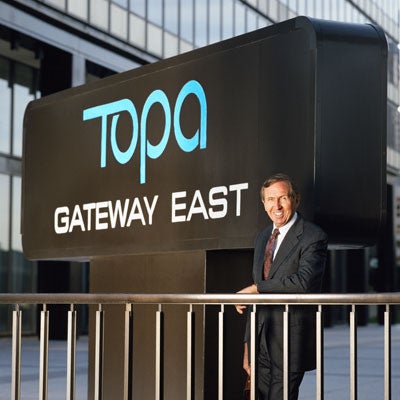
John eventually put the practice of law aside to become a full-time entrepreneur and businessman. His interests were myriad. The family’s company, Topa Equities Ltd., now boasts more than 20 subsidiaries in four divisions, including beverage distribution, automotive, insurance and real estate.
As John built his business, he and Peggy were raising their five children. Sue was the eldest, followed by Judy, John Jr., Debbie and Bill. The family was a close one and became closer after a pair of tragedies “Our mother died at 45 of cancer. Our youngest brother was only six. It was tragic. Then, four years later, our 17-year-old sister, Debbie, died in a car accident. I think it helped that our Dad could focus on his work, which was his passion,” Sue says. “And I think he was just the type of person who was always counting his blessings.”
“He was somebody who knew how to adapt to loss,” agrees Judy. “In his personal life, I think he tried to remain the optimistic, positive person that he was by nature. He also knew how to adapt to loss as a businessman. Lots of people think that he had nothing but success. But he did have businesses that failed and he put the failures behind him and was hopeful about the future.”
After Peggy passed away, John met and married his second wife, Marion, who became stepmother to John’s children. It wasn’t an easy time. The close-knit Anderson family mourned its losses while at the same time integrated a new member. Through the challenges, Marion had a positive effect on John.
“I admired her determination. She was very strong-willed. She got things done. And I think she brought our dad out a little bit,” Sue says. “She loved people. She loved being out, and I think Dad was more of an introvert. I think that was good, for she could be a lot of fun. She came into a difficult situation with five children. She really tried hard with all of us and I think we all appreciate that.”
Marion made her impact on the family business as well.
“I spent a great deal of time with Marion, particularly the last 25 years, because I was working in Los Angeles for our family’s company,” Judy says. “I admired her self-confidence. She also had great instincts for business. She could be very shrewd and analytical.”

By the 1980s, John had re-engaged with his alma mater. He taught courses at what was then UCLA’s Graduate School of Management and, at the invitation of the school’s dean, Clay La Force, joined its Board of Visitors (now known as the Board of Advisors). He also liked taking long strolls through the campus. He and La Force formed a friendship and spoke frequently about the future of the institution, discussing such issues as curriculum, faculty chairs, lessening the dependence on state funding and even the physical space GSM occupied on the UCLA campus. This latter issue was particularly important to John. For the school of management to be world-class, he'd say, it needed a world-class facility.
Together — and with the backing of Chancellor Charles Young — La Force and John Anderson set out to find a “name donor” for the school. After a series of meetings with prime sponsors failed to land a commitment, John had had enough.
“I’ll do it,” he told La Force and the rest of the search committee. Of course, he would need to consult with Marion.
John set three conditions for his commitment: the school would be named after him; the Andersons’ gift would be used entirely for a new facility; and the new complex would be built at the corner of Sunset and Westwood. Chancellor Young accepted. UCLA’s Graduate School of Management formally became the John E. Anderson Graduate School of Management at UCLA.
Since then, the school’s unofficial moniker has morphed from “The Anderson School” to “AGSM” to “UCLA Anderson,” although the official name remains unchanged.
Another constant has been the Anderson family’s commitment to the institution. In 2015, four years after John’s passing, Marion gave the school a game-changing $100 million dollar gift, which facilitated the building of Marion Anderson Hall, opening in 2020.
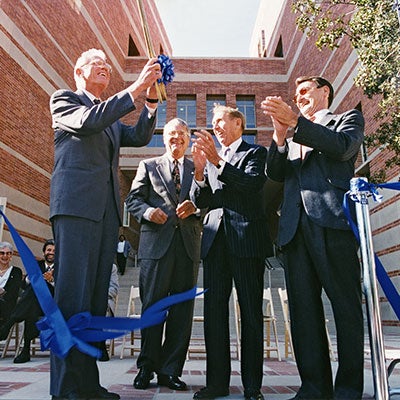
Their involvement in the school runs deeper than their generous financial commitment. Patriarch John, of course, taught courses and served on the Board of Visitors. Marion also served on the Board, becoming a trusted friend and advisor to Dean Judy Olian, and Bill is currently a member. In 2018, Bill delivered the keynote at the commencement ceremony for Anderson’s full time, fully-employed, executive and Ph.D. graduates. John Jr. (’77) is an Anderson alumnus and Judy serves on the board of the Harold and Pauline Price Center for Entrepreneurship and Innovation.
In tangible terms, the Anderson family legacy most obviously manifests through the name of the school as well as the courtyard and edifice that bear Marion’s name. Their financial contributions have benefited students and faculty, both in the classroom and in their research. But the intangible impact is felt strongly as well, through the values John and his family imparted.
Most importantly, John believed deeply in the value of education.
“He emphasized (to us) at a very young age the importance of education,” says grandson Peter Munzig. “I heard him say a couple of times, ‘You should always be taking a class and you should always be teaching a class.’ He loved to be an instructor and he loved this concept of imparting knowledge to folks and helping people arrive at an outcome, and he was terrific at it. He was a great instructor and a great professor. It was fun to see little snippets of that when I was working summers with him.”
“My dad was very passionate about education,” says John Jr. “He gave his original gift to UCLA to the business school because he believed education was the foundation of his success as a business person. This was his home. This was his university. He loved the school and he thought that the school would be very valuable, not just to the students, but to the Los Angeles community at large. And it has been.”
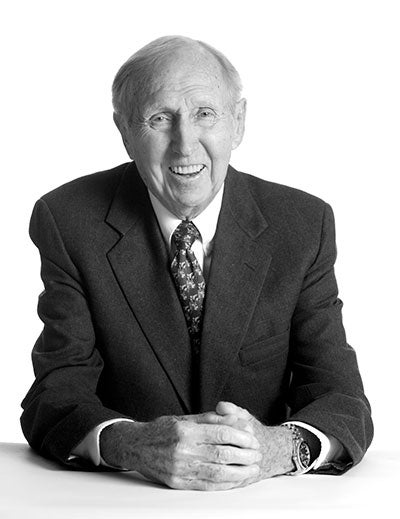
John’s belief in education was the catalyst for his support of UCLA Anderson. That was underscored by his deep convictions about ethical business dealings, a point of emphasis in Anderson’s curriculum. In conversation, his family all reference what he called doing the “right thing.”
“He wanted to treat people well in every transaction,” says Bill. “I think (that’s) incredibly important, particularly in today’s world, even more than in my dad’s. He came from a world where a handshake meant everything. I would tell him, ‘I think we need to document this,’ but he would often respond, ‘No. I shook on it.’ There were times when he got taken as a result of not documenting an agreement that he thought was in place, but it didn’t matter to him. He wanted to believe in people and wanted to take them at their word.”
But maybe the most enduring legacy of the Andersons is their sense of family, their humble beginnings and the value they put on helping others.
“The YMCA had an influence on him when he was young. He would talk about that a lot, how they gave him his first pair of tennis shoes,” says Sue. In turn, John and Marion became major benefactors of the Y and John served as chairman of the YMCA of Metropolitan Los Angeles.
John was equally supportive of Marion’s philanthropic efforts with a number of causes, including Children’s Hospital of Los Angeles, where their $50 million gift led to the building of the Marion and John E. Anderson Pavilion.
“They both cared deeply about philanthropy and service and education, and my dad felt grateful to UCLA for what the school meant to him in his life and in his business,” says Judy. “And Marion wanted to support the school, I think, because she hadn’t had the privilege of a fine education herself. So, she was even more determined that other people have it. She cared a great deal about financial aid because she was really aware of how tough it is for students who don’t have the financial means to go to school.”
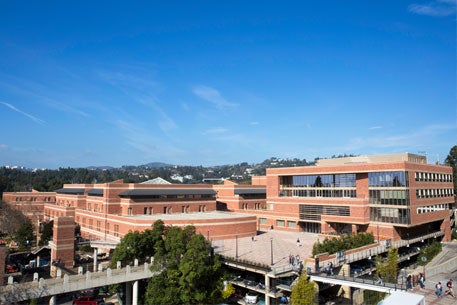
It is perhaps fitting that John Anderson conditioned his naming gift to his alma mater’s business school on a requirement that the school build a first-class facility and that years later, Marion Anderson's transformative gift would add a new structure to the complex. Just as the halls of brick-and-mortar will be a physical home to cutting-edge learning and research for generations to come, the inspiring influence of the Anderson family will be felt for as long as the buildings stand tall.


